Solar generator for a camper: how to choose the size
Disclosure: Some links in this guide are affiliate links. If you buy through them we may earn a commission, at no extra cost to you. We only link to products the guide is about. How we make money.
On this page
- The short answer
- What a solar generator for an RV or camper is
- Watts and watt-hours in plain words
- What size solar generator for an RV?
- A worked example for a weekend away
- Table: what to match to what
- Charging and storing a lithium unit safely
- Keep it plug-in, and call an electrician for fixed wiring
- Comparison
- FAQ
- Sources
- What to do next
The short answer
A solar generator for a camper is a portable power station paired with solar panels. To pick a size, add up the watt-hours your devices use in a day. Then choose a unit with more capacity than that. It also needs enough AC watts for your biggest device, and enough solar input to refill it.
What a solar generator for an RV or camper is
A solar generator is not an engine. It is a battery box (a portable power station) that you charge from solar panels. Sellers may offer panels and a power station together.
The battery inside is the part that stores energy. As an example, EcoFlow's DELTA 2 page lists a "LiFePO4 Battery". It also says "DELTA 2 lets you store 1kWh." 1 A kWh is 1,000 watt-hours, so that is about 1,000 Wh of storage.
In this guide we use EcoFlow's page only as an example of the figures you will see on a spec sheet. We have not tested the unit, and we are not saying it is the right choice for you.
Watts and watt-hours in plain words
Two numbers matter most. Watts tell you how fast a device uses power. Watt-hours tell you how much energy it uses over time.
Wikipedia gives a simple example: "An electric heater consuming 1,000 watts (1 kilowatt) operating for one hour uses one kilowatt-hour of energy". 3 So watts multiplied by hours gives watt-hours.
Wikipedia adds that "Metric prefixes are used for multiples and submultiples of the basic unit, the watt-hour." 3 That is why you see both Wh and kWh on spec sheets.
What size solar generator for an RV?
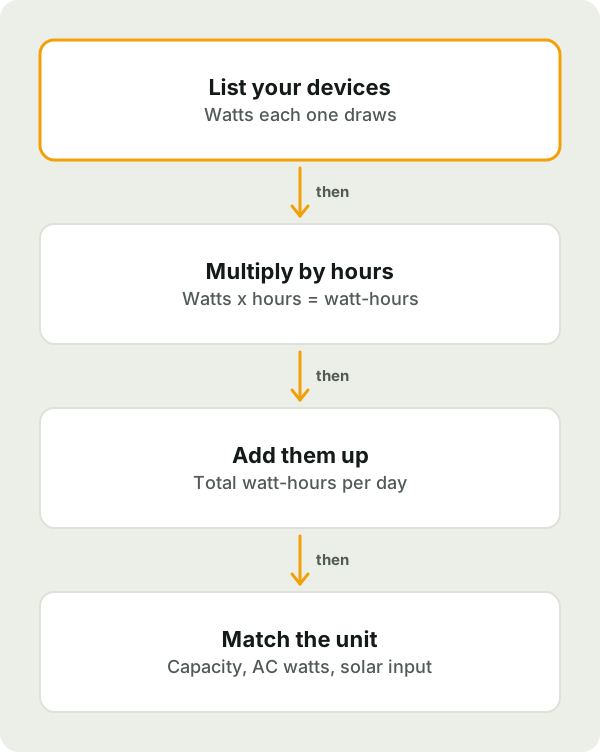
Work through it in four steps, as the diagram shows.
1. List the devices you will run. 2. Find each device's watts on its label or manual. 3. Multiply by the hours you use it each day. 4. Add the results to get your daily watt-hours.
Here is an example only. The wattages below are made-up round numbers to show the sums, not measurements. Check your own devices.
A worked example for a weekend away
Say a camper has a fridge, some lights, a laptop and a phone. Say those add up to 600 Wh a day (an example, worked out as watts times hours). 3 A unit with about 1,000 Wh of storage would leave room for a cloudy day. Allow some margin for losses.
The second number is AC output. Add up the watts of everything you might run at the same moment. EcoFlow's page lists "an impressive 1800W AC output" for the DELTA 2, so a unit like that suits a few small devices at once. 1 Heavy heating appliances can ask for more than that, so check the label first.
The third number is solar input. The same page says you can "get up to 500W input to charge from anywhere" and shows "Recharging using solar in 2.3 hr". 1 The page's image caption suggests the figure assumes two 220W panels, so treat it as the maker's best case. Real charging time depends on sun, panel angle and shade.
Table: what to match to what
Use this table as a checklist when you compare spec sheets. The example column uses the figures quoted above from EcoFlow's page. Ask each seller for the same four figures, then compare them with your daily watt-hours. If a seller does not list one of these figures, ask for it before you buy, and note where each number came from.
Charging and storing a lithium unit safely
Power stations hold a lot of energy in a lithium battery, so follow the maker's manual first. Energy Safe Victoria advises you to "use chargers supplied or recommended by the product manufacturer". 2
It also says to "check devices while they are charging" and to "unplug products and chargers when the battery is fully charged". 2 For storage it says to "store lithium-ion batteries and equipment, like electric scooters, in cool dry places out of direct sunlight". 2
A parked camper in summer can get very hot. The same page says never to "leave lithium-ion batteries or products in hot places such as in parked vehicles". 2
It also says to "charge lithium-ion batteries or products on a non-flammable surface, such as concrete, ceramic, or steel". 2
Keep it plug-in, and call an electrician for fixed wiring
This guide is about a portable unit you plug things into. It does not cover wiring a power station or inverter into a camper, caravan or vehicle at mains voltage. Ask a licensed electrician before you change any fixed wiring.
Buying matters for safety too. Energy Safe Victoria says to "buy products that contain lithium-ion batteries from a known supplier". 2
Comparison
| What to check | Example from EcoFlow's DELTA 2 page | What it tells you |
|---|---|---|
| Storage | 1kWh | How many watt-hours you can use before recharging |
| AC output | 1800W | Total watts you can run at once |
| Solar input | Up to 500W | How much solar the unit can accept |
| Expansion | 1-3kWh expandable | Whether you can add capacity later |
Frequently asked questions
What size solar generator for an RV?
Add up the watt-hours your devices use in a day (watts multiplied by hours). Then choose a unit with more storage than that total, and with AC watts above the combined load you will run at once.
Is a solar generator the same as a power station?
In this guide, a solar generator means a portable power station that you charge from solar panels. Check what is in the box before you buy.
Can I add more battery later?
Some units can. EcoFlow's DELTA 2 page lists "1-3kWh Expandable Energy Storage". Check the manual for the unit you are buying. 1
Is it safe to charge a lithium power station in my camper?
Follow the maker's manual. Energy Safe Victoria says to "check devices while they are charging" and to "unplug products and chargers when the battery is fully charged". 2
Sources
- DELTA 2 Portable Power Station, EcoFlow. Checked 20 October 2026.
- Lithium-ion battery safety, Energy Safe Victoria. Checked 20 October 2026.
- Watt-hour, Wikipedia. Checked 20 October 2026.